EMP-Proofing Your Solar Charge Controller
In a grid-down scenario triggered by an Electromagnetic Pulse (EMP) or a massive Coronal Mass Ejection (CME), your solar power system is your lifeline. While solar panels themselves are somewhat resilient due to their simple construction, the Solar Charge Controller is the “brain” of your system—and its microelectronics are highly susceptible to being fried by induced currents.
1. Understanding the Threat
An EMP creates a massive burst of electromagnetic energy that induces high-voltage spikes in any conductive material. Your solar array acts like a giant antenna, funneling thousands of volts directly into your charge controller. Without protection, the sensitive MOSFETs and logic circuits inside will fail instantly.
Primary Strategy: The Faraday Cage The most effective way to protect electronics is a Faraday cage. For a charge controller, this means either storing a “spare” in a shielded container or shielding the unit while it is in operation.
Recommended Product: Mission Darkness Faraday Bags for Electronics
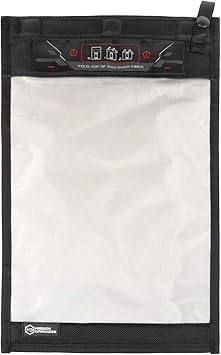 Mission Darkness NeoLok Window Faraday Bag for Tablets (+ Secure Magnetic Closure & Transparent Window) // Device Shielding for Law Enforcement & Military, Data Security, Anti-Hacking & An...$90.00Buy NowWe earn a commission if you make a purchase, at no additional cost to you.06/16/2026 11:59 am GMT
2. Hardening an Active System
You cannot put your active controller in a sealed box because it needs ventilation and wiring. Instead, you must focus on Point-of-Entry (POE) Protection.
Transient Voltage Surge Suppressors (TVSS)
Install high-speed Surge Protective Devices (SPDs) on both the PV (Solar Panel) input side and the Battery output side. Use devices specifically designed to handle the nanosecond rise-time of an E1 pulse.
- PV Side: Install a DC surge protector rated for your array’s voltage.
- Battery Side: Protect the DC bus from surges induced in the battery cables.
Note: Standard household surge protectors are often too slow for an EMP; look for “EMP-rated” devices like those from EMP Shield.
3. Ferrite Cores and Chokes
Snap-on ferrite cores are an inexpensive way to suppress high-frequency noise and minor surges. By placing them on the wires entering and exiting the charge controller, you create “chokes” that resist the rapid current changes caused by an EMP.
- Recommended Product: Ferrite Core 24-Piece Set

4. Shielding the Housing
If your charge controller has a plastic housing, it offers zero protection against E2 and E3 pulses.
- Metal Enclosure: Mount your controller inside a grounded steel electrical box (NEMA enclosure).
- Grounding: Ensure the enclosure is tied to a dedicated 8-foot copper ground rod. The goal is to give the pulse a path of least resistance ($R \rightarrow 0$) to the earth rather than through your hardware.
5. The Redundancy Principle
Even with the best protection, there is no 100% guarantee. The ultimate “EMP-proof” strategy is to have a Backup Charge Controller stored in a high-quality Faraday bag or a nested metal “trash can” Faraday cage.
Essential Backup Gear
A simple, rugged PWM controller is often more resilient than complex MPPT controllers for emergency backups. Consider keeping a high-quality unit in a shielded bag.
- Recommended Product: Victron Energy SmartSolar Charge Controller

LEAVE A COMMENT